Core Technical Architecture
High-Density LiFePO4 Battery Technology
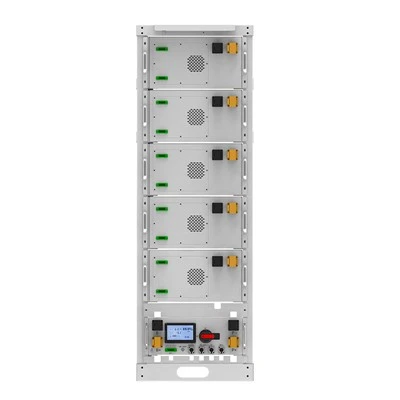
Chemistry: Lithium Iron Phosphate (LiFePO4), selected for its stable olivine crystal structure that resists thermal runaway under high-stress operation.
Cycle Life: Rated for 6,000+ cycles (tested at 25°C ambient temperature with 0.5C/0.5C charge-discharge rates, retaining 80% initial capacity).
Operational Design Life: Engineered for 10+ years of continuous stationary service, lowering long-term hardware replacement frequency.
Multi-Tier Intelligent Battery Management System (BMS)
The integrated BMS operates on a three-tier architecture (Master BMS, Cluster BMS, and Slave/Cell BMS) to maintain operational safety and maximize usable capacity:
Real-Time Parameter Tracking: Continuously monitors individual cell voltages, module temperatures, and aggregate rack current.
Active Cell Balancing: Automatically redistributes energy between cells during charging to prevent premature capacity fade caused by voltage drift.
Fault Isolation: Features hardware-level interlocks and programmable trip points for over-voltage, under-voltage, over-current, and short-circuit protection.
Precision Thermal Management Systems
To prevent thermal degradation and capacity loss, our containers utilize two engineered cooling layouts depending on local climate demands:
Smart Air Cooling: Utilizes variable-speed HVAC units with optimized internal airflow channels to keep internal ambient temperatures within strict operating thresholds.
Liquid Cooling (Optional): Employs glycol-water coolant plates attached directly to battery modules, maintaining inter-cell temperature variances within ±3°C to maximize uniformity and extend service life.
Turnkey Containerized Integration
Systems arrive pre-assembled in 20ft or 40ft ISO containers (IP54/IP55 rated), housing:
- Battery racks and internal busbars
- BMS control panels and PLC controllers
- HVAC or liquid cooling skids
- Aerosol or gas-based fire suppression systems
- Power conversion system (PCS) integration interfaces (CAN, RS485, Modbus TCP/IP, Ethernet)
Application Scenarios
Renewable Energy Integration: Smooths out intermittency in utility-scale solar farms and wind parks, capturing excess generation during low-load windows and dispatching power during peak demand hours.
Grid Support & Ancillary Services: Deployed for frequency regulation, spinning reserve substitution, and peak shaving to lower utility demand charges for heavy industrial plants.
Microgrids & Off-Grid Power: Powers remote mining sites, island grids, and data centers requiring uninterrupted baseline power paired with diesel generator sets.
Technical Specifications
|
Parameter |
Specification Details |
|
Battery Chemistry |
Lithium Iron Phosphate (LiFePO4) |
|
System Configuration |
Modular, Containerized (20ft / 40ft ISO or custom enclosures) |
|
Energy Capacity |
Scalable from MWh-level up to hundreds of MWh |
|
Design Cycle Life |
6,000+ cycles (at standard test conditions) |
|
Round-Trip Efficiency |
≥ 90% (system-level configuration dependent) |
|
Enclosure Protection |
IP54 / IP55 weather-resistant ratings |
|
Communication Protocols |
Modbus RTU, Modbus TCP/IP, CAN, IEC 61850 (optional) |
|
Compliance & Standards |
CE, UN38.3, IEC 62619, UL 9540/9530A compliant options available |
Manufacturing & Quality Assurance
We maintain end-to-end control over production quality to ensure field reliability:
Cell Sorting & Screening: Incoming cells undergo automated grading based on capacity, internal resistance, and open-circuit voltage (OCV) curves to ensure tight pairing within modules.
Module & Rack Testing: All assembled strings undergo high-voltage insulation resistance testing and automated weld-integrity checks.
Full-System Factory Acceptance Testing (FAT): Completed systems undergo simulated charge-discharge cycling, communication stress tests, and thermal subsystem verification prior to dispatch.
OEM/ODM Customization Services
We work directly with global partners to tailor BESS hardware and software to local project requirements:
Capacity & Footprint: Custom enclosure sizing and energy scaling based on strict site plot limits or transport weight limits.
Electrical Integration: Voltage class matching for specific PCS integration (e.g., 1000VDC or 1500VDC system architectures).
Private Labeling: Custom color codes, branding decals, documentation packages, and localized HMI interface software languages.
FAQ
Hot Tags: large scale lithium battery energy storage system, China large scale lithium battery energy storage system manufacturers, suppliers, factory